


Summary
Our laboratory is dedicated to the study of the molecular and physiological bases of memory, adopting an approach that integrates multiple scales of the phenomenon through physiological and comparative perspectives. Our research focuses on the processes involved in information storage and its use in prediction, particularly over the long term.
The use of multiple experimental models provides a comparative framework in which we seek to employ the most suitable systems for addressing different aspects of memory research. We are convinced that cognitive science can and should adopt a more comparative approach to the study of cognitive phenomena, and that such an approach brings us closer to a deeper understanding of these systems in humans.
To achieve a comprehensive understanding of the mechanisms underlying memory storage, we integrate insights and methodologies from multiple levels of analysis, including neurobiology, evolutionary biology, and behavioral studies. This multidisciplinary perspective enables us to investigate memory from molecules to organisms, providing a broader view of the processes that govern learning, memory formation, and information retention.
Scientific summary
From a bottom-up perspective, we investigate the dynamics of macromolecular interactions within the polarized architecture of cells in the nervous system. Historically, our work has focused on the dynamics of components of the NF-κB signaling pathway in the nervous system (Freudenthal & Romano, 2000; Freudenthal et al., 2005; Boccia-Freudenthal, 2007). This knowledge, together with the diverse functions and ubiquitous nature of NF-κB, has enabled us to advance our understanding of synapse-to-nucleus communication. By analyzing the dynamics of this signaling pathway, we have investigated: (1) synaptic physiology during memory consolidation (Salles et al., 2014, 2015), and (2) the regulation of surface expression of NMDA-type glutamate receptor subunits (Hepp-Salles, 2015). The latter studies led to the hypothesis that the maturation state of a memory trace influences how it becomes associated with newly acquired memories.
At a broader scale, the same NF-κB activation system allowed us to identify the brain regions required for the consolidation of aversive memories compared with appetitive (relief-related) memories in mice (Salles et al., 2017), providing insight into the systems-level organization of memory consolidation.
From a top-down perspective, we aim to study memory in predation-related environments in order to understand learning under life-threatening conditions. In invertebrates, this line of research is conducted by comparing learning under predation risk with classical olfactory learning paradigms in which survival is not directly threatened.
Our research employs multiple animal models, each selected for its suitability to address specific questions in memory biology. Studies of synaptic physiology and the neural circuitry required for the consolidation of memories with different emotional valences are conducted in CF1 mice. The maturation of memory traces and their capacity to integrate with newly acquired memories are investigated using two memory paradigms in the crab Neohelice granulata. Memory under predation-related conditions is studied using the predator–prey system composed of Drosophila melanogaster and Menemerus semilimbatus.
The use of multiple experimental models reflects our comparative approach, in which we seek to employ the most appropriate biological systems for addressing different aspects of memory research. We believe that comparative cognitive science provides a powerful framework for understanding the fundamental mechanisms of learning and memory and for translating these insights to human cognition.
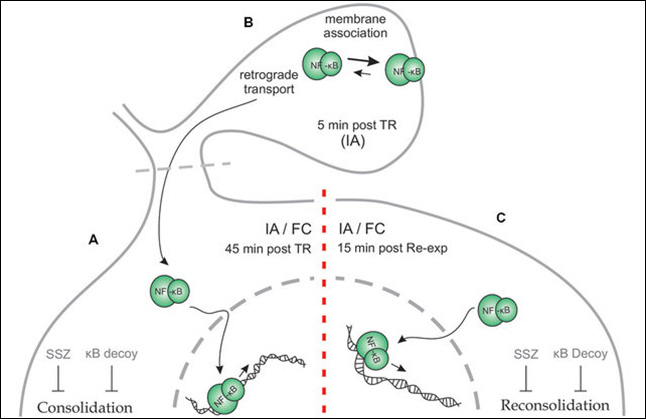
Figura 1: Papel del factor de transcripción NF-kappa B en la consolidación y reconsolidación de la memoria de evitación inhibitoria. Adaptado de NF-κB transcription factor role in consolidation and reconsolidation of persistent memories V de la Fuente, N Federman, G Zalcman, A Salles, R Freudenthal, and A Romano. Front Mol Neurosci. 2015; 8: 50.
Lines of research
Role of Protein Acetylation-Mediated Regulation of Synaptic Composition in Long-Term Memory Consolidation in Mice
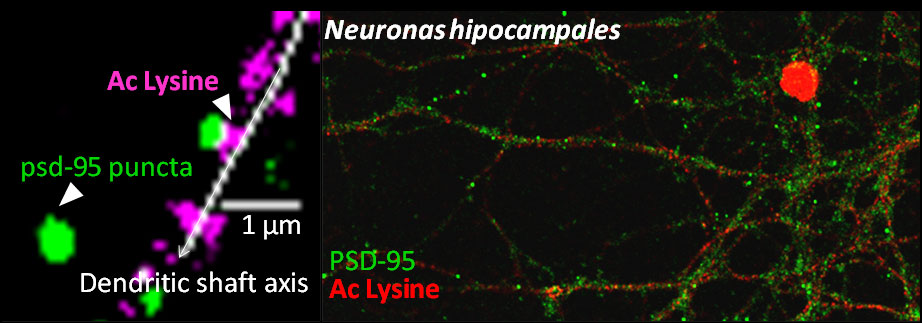
Figura-2 : Inmunofluorescencia de cultivo de neuronas hipocampales.
Objective: The objective of this project is to investigate the acetylation of synaptic proteins and histones during memory consolidation, with the aim of understanding how this post-translational modification regulates the presence of key proteins, such as receptors and scaffolding proteins, at the synapses involved in memory formation. This project examines this signaling pathway under physiological conditions in order to elucidate how the clearance of synaptic proteins is regulated by the opposing activities of lysine acetyltransferases (KATs) and lysine deacetylases (KDACs). The study is relevant for advancing our understanding of memory consolidation and the cognitive effects observed in several disorders in which the acetylation of synaptic proteins is disrupted.
Study of the Role of NF-κB in Neural Circuits Involved in the Consolidation and Reconsolidation of Appetitive Memory
Objective:
To investigate the role of NF-κB in the consolidation and reconsolidation of appetitive memory, and to identify the brain regions and neuronal circuit connections involved in this type of memory.
“Memory Dynamics During Sequential Learning: The Role of NMDA Receptor Surface Expression”

Figura 3: Arriba cangrejo Neohelice granulata en su ambiente (izq). Entrenamiento de preferencia de lugar (der). Abajo entrenamiento de de memoria contexto-señal.
Objectives: The main objective of this research project is to investigate whether different levels of surface expression of the NMDA-type receptor in Neohelice granulata affect the sequential acquisition of two forms of memory that depend on this receptor. Specifically, we aim to determine what happens to the retention of the first memory when animals are exposed to a second learning experience at different time intervals after training on the first task. This second learning experience may involve either a similar sensory integration process or a completely different one.
Review of Fear Memory in Drosophila melanogaster: Similarities and Differences Between Electric Shock and Predation Environments

Figura 4: Araña y arena de entrenamiento de Drosophila.
Objectives:
- To identify the neuronal populations recruited during the formation of fear memory induced by exposure to a predation environment.
- To evaluate whether the synaptic plasticity underlying this form of memory depends on signaling pathways involving the activity of rutabaga, dunce, PKA, and related molecular components.
- To compare the results obtained from the predation-induced fear paradigm with those of aversive memory induced by electric shock (through both published literature and laboratory experiments), focusing on the neuronal populations and molecular mechanisms involved in each type of memory.
Members:
Valentino Vittorio Morazzo Nunzi
PhD student
UBA Fellow, Bachelor Thesis Student
Melina Sol Alvarez
Bachelor Thesis Student
Outreach notes
Outstanding publications
1: Freudenthal RAM, Romano A, Baez MV. Editorial: Changes in Molecular Expression After Memory Acquisition and Plasticity. Looking for the Memory Trace. Front Mol Neurosci. 2020 Apr 3;13:50. doi: 10.3389/fnmol.2020.00050. PMID: 32317930; PMCID: PMC7146821.
2: Salles A, Krawczyk MDC, Blake M, Romano A, Boccia MM, Freudenthal R. Requirement of NF-kappa B Activation in Different Mice Brain Areas during Long- Term Memory Consolidation in Two Contextual One-Trial Tasks with Opposing Valences. Front Mol Neurosci. 2017 Apr 7;10:104. doi: 10.3389/fnmol.2017.00104. PMID: 28439227; PMCID: PMC5383659.
3: Hepp Y, Salles A, Carbo-Tano M, Pedreira ME, Freudenthal R. Surface expression of NMDA receptor changes during memory consolidation in the crab Neohelice granulata. Learn Mem. 2016 Jul 15;23(8):427-34. doi: 10.1101/lm.041707.116. PMID: 27421895; PMCID: PMC4947233.
4: de la Fuente V, Federman N, Zalcman G, Salles A, Freudenthal R, Romano A. NF- κB transcription factor role in consolidation and reconsolidation of persistent memories. Front Mol Neurosci. 2015 Sep 9;8:50. doi: 10.3389/fnmol.2015.00050. PMID: 26441513; PMCID: PMC4563083.
5: Salles A, Boccia M, Blake M, Corbi N, Passananti C, Baratti CM, Romano A, Freudenthal R. Hippocampal dynamics of synaptic NF-kappa B during inhibitory avoidance long-term memory consolidation in mice. Neuroscience. 2015 Apr 16;291:70-80. doi: 10.1016/j.neuroscience.2015.01.063. Epub 2015 Feb 7. PMID: 25659345.
6: Sol Fustiñana M, de la Fuente V, Federman N, Freudenthal R, Romano A. Protein degradation by ubiquitin-proteasome system in formation and labilization of contextual conditioning memory. Learn Mem. 2014 Aug 18;21(9):478-87. doi: 10.1101/lm.035998.114. Erratum in: Learn Mem. 2014 Nov;21(11):646. PMID: 25135196; PMCID: PMC4138359.
7: Salles A, Romano A, Freudenthal R. Synaptic NF-kappa B pathway in neuronal plasticity and memory. J Physiol Paris. 2014 Sep-Dec;108(4-6):256-62. doi: 10.1016/j.jphysparis.2014.05.002. Epub 2014 May 20. PMID: 24854662.
8: Hepp Y, Tano MC, Pedreira ME, Freudenthal RA. NMDA-like receptors in the nervous system of the crab Neohelice granulata: a neuroanatomical description. J Comp Neurol. 2013 Jul 1;521(10):2279-97. doi: 10.1002/cne.23285. PMID: 23238970.
9: Yang M, Carbó Tano M, Freudenthal R, Hermitte G. Characterization of the cardiac ganglion in the crab Neohelice granulata and immunohistochemical evidence of GABA-like extrinsic regulation. Arthropod Struct Dev. 2013 Jan;42(1):17-25. doi: 10.1016/j.asd.2012.09.002. Epub 2012 Sep 14. PMID: 22986313.
10: de la Fuente V, Freudenthal R, Romano A. Reconsolidation or extinction: transcription factor switch in the determination of memory course after retrieval. J Neurosci. 2011 Apr 13;31(15):5562-73. doi: 10.1523/JNEUROSCI.6066-10.2011. PMID: 21490196; PMCID: PMC6622842.
11: Fustiñana MS, Ariel P, Federman N, Freudenthal R, Romano A. Characterization of the beta amyloid precursor protein-like gene in the central nervous system of the crab Chasmagnathus. Expression during memory consolidation. BMC Neurosci. 2010 Sep 1;11:109. doi: 10.1186/1471-2202-11-109. PMID: 20809979; PMCID: PMC2940927.
12: Boccia M, Freudenthal R, Blake M, de la Fuente V, Acosta G, Baratti C, Romano A. Activation of hippocampal nuclear factor-kappa B by retrieval is required for memory reconsolidation. J Neurosci. 2007 Dec 5;27(49):13436-45. doi: 10.1523/JNEUROSCI.4430-07.2007. PMID: 18057202; PMCID: PMC6673108.