
Summary
In our laboratory, we seek to understand the molecular and cellular aspects of developmental programs, differentiation, and morphogenesis using the amoeboid protist Dictyostelium discoideum (dictybase.org) as a model system.
D. discoideum has a particularly attractive life cycle for these studies. On the one hand, it displays a relatively simple developmental and differentiation program, with essentially two main cell types (stalk cells and spores). On the other hand, its life cycle clearly separates the growth phase (vegetative cycle) from the multicellular phase (social cycle).
During its multicellular developmental program, however, remarkably complex and fundamental features of developmental biology take place, including collective cell migration; decision-making in the absence of positional information followed by cell sorting; the formation of dynamic epithelial structures with mesenchymal-to-epithelial and epithelial-to-mesenchymal transitions; and the ability to change cell fate commitment in response to environmental cues (transdifferentiation).
Studying these processes in D. discoideum also provides an evolutionary perspective, helping us to understand them in a more comprehensive and integrated manner.
Lines of Research:
In cell fate decision-making and its maintenance. In D. discoideum, cell fate determination is not driven by morphogen concentration gradients, in which cells commit to a specific fate depending on their position and the local concentration of a morphogen they sense. Instead, commitment occurs in the absence of positional information: cells first acquire a defined fate and subsequently migrate to their appropriate location within the organism.
This mechanism of fate decision followed by cell sorting is not exclusive to D. discoideum; it also operates in metazoan developmental programs, such as during the formation of the retinal pigment epithelium, where precursor cells arise at the neural crest and must migrate to the developing eye, or during the migration of primordial germ cells.
In D. discoideum, cells must choose between only two lineages: stalk cells and spores. It has long been known that the molecule DIF-1 can induce in vitro differentiation into stalk cells by activating stalk-specific gene expression and repressing prespore genes. DIF-1 is synthesized by the prespore lineage and degraded by the prestalk lineage, potentially generating a feedback circuit that regulates the proportion of each lineage (Fig. 1).
DrcA encodes the enzyme responsible for the first—and rate-limiting—step in DIF-1 degradation. In previous work, we identified the drcA gene and, through production and purification of the protein, elucidated the enzyme’s mechanism of action as well as its kinetic parameters and substrate affinity constants.
Currently, we are characterizing its expression pattern and identifying the regulatory elements that control its expression. Which prestalk subpopulation expresses it? When does its expression begin? Is it induced during transdifferentiation processes? How does substrate induction occur?
To address these questions, we use reporter constructs such as lacZ, GFP, and mRFP, as well as the generation of KO, KI, and overexpressing strains.
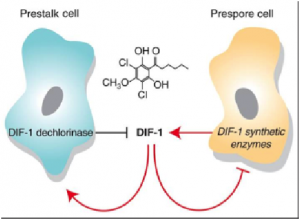
(from doi:10.1101/cshperspect.a001503)
During multicellular developmental programs, epithelia constitute the basic units of morphogenetic processes. Developmental biology can, in many ways, be summarized as the set of mechanisms by which living organisms build and subsequently shape epithelia. This shaping, according to a pre-established plan, organizes epithelial structures, ultimately leading to the formation of organs, systems, and finally the adult organism.
Epithelia have traditionally been considered an innovation of animals (metazoans), in which cells acquire a defined internal organization (apico-basal polarity) and establish specific types of intercellular junctions (tight junctions, gap junctions, etc.), thereby defining epithelial properties and conferring structural robustness.
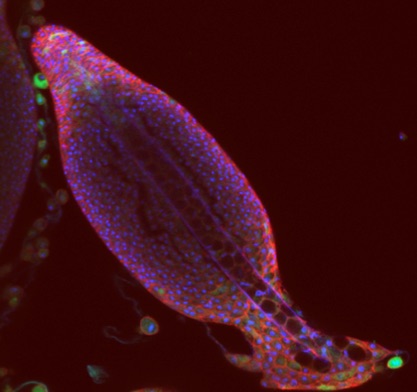
Proper cellular packing within epithelia (or its alteration) is crucial for the successful completion of developmental programs. Some time ago, it was described that during the multicellular development of Dictyostelium discoideum, this organism forms a structure reminiscent of metazoan epithelia. In our laboratory, we aim to analyze the cellular dynamics within this structure, assess to what extent metazoan epithelia are comparable to those of D. discoideum, and investigate the mechanisms regulating their assembly and disassembly.
Using fluorescence microscopy techniques, we are characterizing cellular packing within this structure. We have also observed that apico-basal transitions occur in the D. discoideum epithelium, likely serving to accommodate the mechanical tensions generated during epithelial folding.
In our laboratory, Ana Belén Benítez dos Santos, as part of her undergraduate thesis, initiated the analysis and characterization of this epithelial structure. At the following link, you can find a summary of her thesis and some of her results.
Gallery

Members:
Ana Belén Benítez dos Santos
benitezbelen843@gmail.com
Undergraduate student
Micaela Daiana Aranda
mica.aranda@yahoo.com.ar
Undergraduate student