

Summary
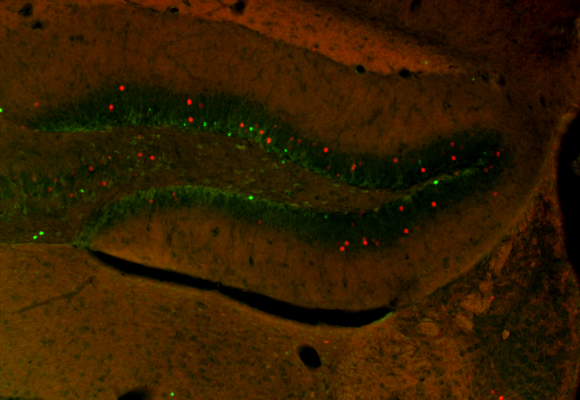
The Experimental Neurogenesis Laboratory studies the process of new neuron formation in the adult brain, as well as several factors that modulate this physiological process. We use mice as an experimental model for our studies and develop behavioral assays, neurochemical determinations, immunohistochemistry, immunofluorescence, and Western blot techniques. In particular, we study how different configurations of the serotonergic system—generated by drugs such as antidepressants or genetically modified animal models—affect neuronal survival in the adult hippocampus. Likewise, we investigate the neurogenic and behavioral effects in mice treated with medicinal cannabis oils, and we have recently launched a project aimed at elucidating the antidepressant mechanism of action of psilocybin.
In the lab, we are also dedicated to studying the welfare of laboratory animals, specifically mice under production or experimental conditions within animal facilities. Finally, we collaborate with a team of researchers concerned with the well-being of individuals who conduct animal experimentation and bear an often-overlooked emotional burden known as “compassion fatigue.”
Gallery

Research Lines
Our laboratory is interested in understanding the role played by the serotonergic system in modulating adult hippocampal neurogenesis, as serotonin plays a key role in the development of the Nervous System, social behaviors, and mental health. Postnatal administration of serotonergic antidepressants such as fluoxetine to mice induces, in adulthood, a decrease in neuronal survival in the hippocampus as well as deficits in memory and anxiety tests. This effect is diametrically opposed to the well-known pro-neurogenic and cognitive-enhancing effect of Fluoxetine when administered to rodents in adulthood. Furthermore, we found that both these behavioral and neurochemical changes are more pronounced at early ages and specifically in males. Along this research line, we aim to deepen our understanding of the mechanisms underlying these effects by utilizing techniques such as immunofluorescence, neurochemical determinations, and more sophisticated tools like fiber photometry and optogenetics.
Additionally, we have initiated a collaboration with clinical researchers and epidemiologists to enhance the translational potential of the hypotheses guiding our research and to address issues of local relevance.
Phytocannabinoids, the active compounds in Cannabis sativa, act on the nervous system’s receptors, triggering various effects—some of which are medically relevant. While endogenous cannabinoids promote neuronal proliferation in the adult hippocampus, opposite effects have been reported for the purified phytocannabinoids tetrahydrocannabinol (THC) and cannabidiol (CBD). However, little is known about the neurogenic effects of “full-spectrum” medical cannabis oil, in which cannabinoids and terpenes interact synergistically—a phenomenon known as the “entourage effect.” In this project, we study the effects of phytocannabinoids present in commonly used patient-grade cannabis oil on the neurogenesis process in the adult mouse hippocampus, as well as their behavioral and functional consequences.
In this line of research, we use a model of early-life stress in rats to explore the causal relationship between infant maltreatment and the development of behavioral disorders and neurophysiological alterations in juvenile offspring of both sexes. We assess behavioral, endocrine, and morphological characteristics and explore molecular mechanisms related to stress response and neuronal plasticity in the hippocampus of juvenile rats exposed to early-life stress—findings that have strong implications for behavioral and cognitive deficits.
Various international regulations and guidelines recommend adding enrichment elements to the cages of rodents used in production and experimentation, with the aim of improving animal welfare. However, these additions are often empirical and lack scientific validation, and may alter neurochemical processes, hormonal variables, or other biological parameters—potentially interfering with experimental results. In our laboratory, we aim to evaluate commonly used, simple enrichment items that can improve the welfare of laboratory mice without significantly altering their behavior or underlying biochemical processes.
Team Members
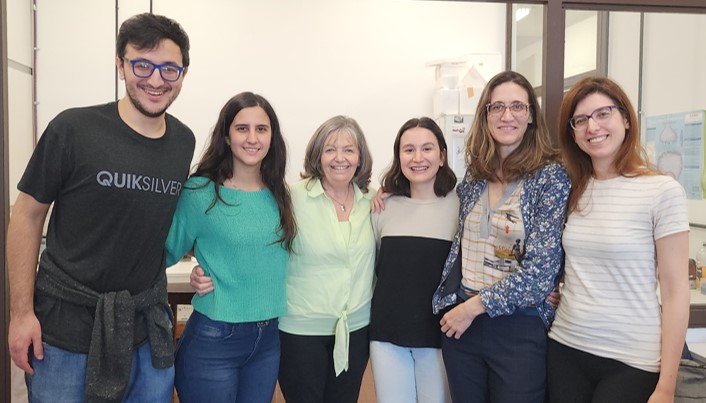
Lic. Karen M. Stefani
PhD Fellow, CONICET
Dr. Ailen A. Colapietro
Postdoctoral Researcher
Lic. Lucas Serniotti
PhD Fellow, CONICET
Dr. Daniela R. Montagna
Postdoctoral Researcher
Science Communication
- Ambiente y medio.
Interview on animal experimentation, broadcast on América TV on 07/19/2026
https://www.youtube.com/watch?v=tXywsU1nEYM - International Brain Research Organization (IBRO). 2025.
IBRO Parenthood Grants: helping new parents balance family life and research
- CONICET. 2024.
Científicas del CONICET estudian los efectos del estrés durante el embarazo y la lactancia sobre la descendencia - Fundacen. 2023.
Fundacen. ETI2. Laboratorio de Neurogénesis experimental. - Clarín. 2017.
Una ley para proteger a los animales en la investigación científica - Revista Anfibia. 2014.
Morir por la Ciencia
Collaborators
Anne Roumier
INSERM, Sorbonne University, NeuroSU.
Christian Hocht
Fac, Farmacia y Bioquímica-UBA.
Mabel Berrueta – Karen Klein
Inst. Efectividad Clinica y Sanitaria
Nicolas Renier
INSERM, París Brain Institute.
Catalina van Baren
Fac, Farmacia y Bioquímica -UBA.
Mariana Nanni
INTA Castelar.
Featured Publications
- Marcoppido, Gisela Ariana; Guidobono, Juan Santiago; Trangoni, Marcos; Mattana, María Aluminé; Resasco, Agustina; and Diaz, Silvina Laura. 2026.
Human – laboratory animal bonds: first cross-sectional study in laboratory animal care professionals in Argentina
Frontiers in Veterinary Science, Mar 6;13:1738072. http://doi: 10.3389/fvets.2026.1738072 - Ailen Alba Colapietro, Jazmín Grillo Balboa, Marianela Noemí Ceol Retamal, Eleonora Regueira, Gladys Noemí Hermida, Verónica Inés Cantarelli, Marina Flavia Ponzio, María Eugenia Pallarés, Marta Cristina Antonelli, Silvina Laura Diaz. 2025.
Infant Maltreatment Induces Early Alterations in Adrenal Glands and Stress Response in Juvenile Rat Offspring
Neurochemical Research, 50:108 - Topilko T, Diaz SL, Pacheco CM, Verny F, Rousseau C, Kirst C, Deleuze C, Gaspar P, Renier. 2022.
Midbrain CART+ peptidergic neurons enables maternal preparatory nesting
Neuron, 2022, 110(8); 1385-99.
- Agustina Resasco & Silvina Laura Diaz. 2022.
Mouse breeding facilities in Argentina: Current state, challenges, and strengths in relation to animal welfare
Frontiers in Veterinary Science, 9:1031976. - Rocio B. Foltran, Karen M. Stefani, Antonela Bonafina, Agustina Resasco, Silvina L. Diaz. 2019.
Differential hippocampal expression of BDNF isoforms and their receptors under diverse configurations of the serotonergic system in a mice model of increased neuronal survival
Frontiers in Cellular Neuroscience,13:384. - Silvina L. Diaz, Nicolas Narboux-Nême, Sara Trowbridge, Sophie Scotto-Lomassese, Felix B. Kleine Borgemann, Sebastian Jessberger, Bruno Giros, Luc Maroteaux, Evan Deneris, Patricia Gaspar. 2013.
Paradoxical increase in survival of newborn neurons in the dentate gyrus of mice with constitutive depletion of serotonin
European Journal of Neuroscience, 38(5): 2650-2658.
- Silvina Laura Diaz, Stéphane Doly, Nicolas Narboux-Nême, Sebastián Fernández, Pierre Mazot, Sophie Marie Banas, Katia Boutourlinsky, Imane Moutkine, Arnauld Belmer, Anne Roumier, Luc Maroteaux. 2012.
5-HT2B receptors are required for serotonin-selective antidepressant actions
Molecular Psychiatry, 17(2): 154-163.