
Summary
We generate, analyze, and integrate multi-omics data from pathogens of relevance to human and animal health using bioinformatic and molecular biology tools.
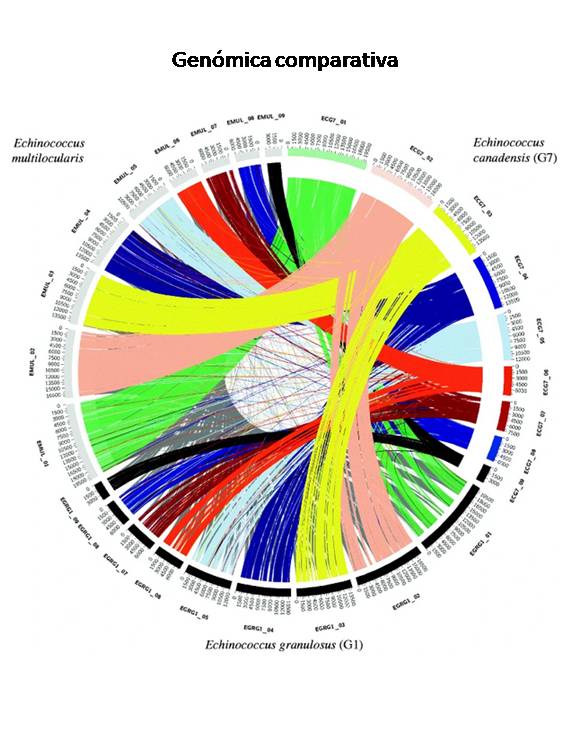
One of our main research lines focuses on parasitic helminths (nematodes, cestodes, and trematodes). These organisms cause severe and difficult-to-treat diseases in humans, animals, and plants. A large proportion of the world’s population—particularly in developing countries—suffers from helminth infections. In Latin America, prevalence is estimated at around 30%. The field of helminthology has been greatly advanced by high-throughput sequencing technologies, which have enabled the assembly of complete genomes and expanded our understanding of genes and pathways essential for parasite survival, such as those reported for cestodes, in projects in which we have participated or are currently conducting. With the generation of complete genome sequences, we have found that a large proportion of parasite genomes consists of genes with no homology to model species, raising important questions regarding their role in parasite development and survival.
The next step in this genomic characterization involves studying the interactions of parasite gene products through functional genomics approaches. In parasites, functional genomics has two dimensions, as their gene products can interact both with parasite molecules and with host molecules. In this context, we have studied several parasite-specific proteins and small non-coding RNAs that are likely to interact with the host.
In addition, we work in a cross-cutting and interdisciplinary manner with research groups at iB3 and with various institutes both within the country and internationally.
Lines of research
We use bioinformatic tools and specialized databases to study rare diseases in humans, using the rat as a model (in collaboration with the lab Genetics and Genomics of Human Hereditary Diseases) and the amoeboid protist Dictyostelium discoideum (in collaboration with the lab Development and Morphogenesis in Dictyostelium discoideum). In these projects, information derived from complete genomes is used to determine the degree of conservation of genes involved in different rare diseases with respect to these laboratory models, as well as to identify sequences that play a role in gene regulation.
The integration of DNA sequence and gene expression analyses with existing medical information allows us to more precisely identify the genetic determinants of these diseases. In addition, to generate new multi-omics data, we are incorporating third-generation sequencing technologies (Oxford Nanopore).
Massively parallel sequencing, also known as next-generation sequencing (NGS), has enabled a leap of several orders of magnitude in the number of genes that can be studied simultaneously. This methodology allows the analysis of an organism’s entire genome, its coding regions (exome), or a selected set of genes of interest (gene panels or targeted sequencing). It is also possible to analyze all genes being expressed in a given cell type or condition (transcriptomics), as well as to study microbial communities in biological samples (metagenomics) and their expression (metatranscriptomics) without the need for isolation or cultivation.
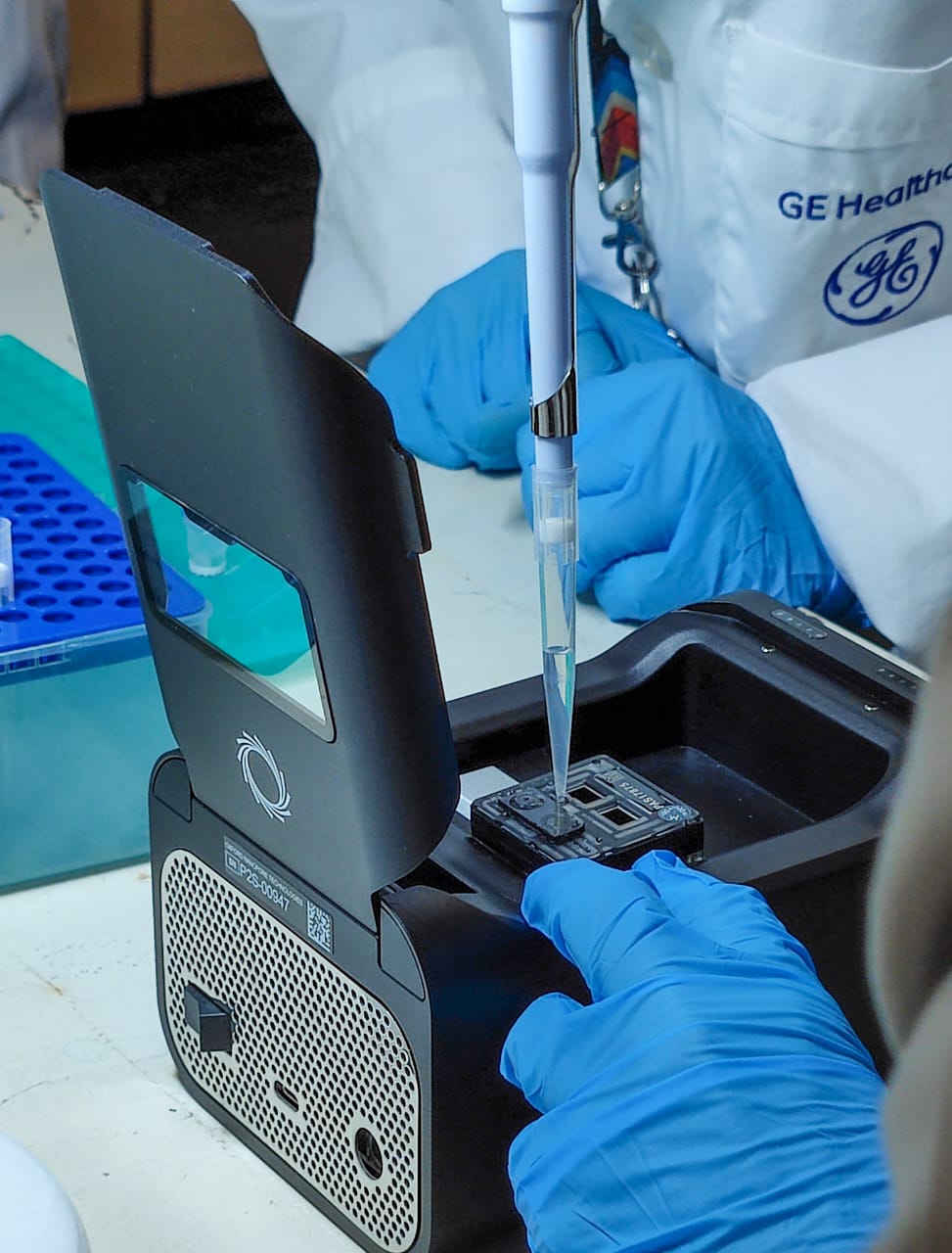
Currently, several platforms and technological developments are available for these large-scale studies. The Oxford Nanopore Sequencing Platform at iB3 is based on nanopores that detect the passage of DNA or RNA molecules. This technology enables the “native” sequencing of DNA or RNA molecules without prior amplification or the need for intermediate sequencing steps, and allows the generation of long reads (10,000 to 50,000 nucleotides).
The production of longer sequences facilitates efficient assembly of genomes, metagenomes, and transcriptomes, reducing computational time and simplifying assembly algorithms. It also enables the resolution of regions containing repetitive sequence motifs, which are difficult to assemble using short-read sequencing technologies. Additionally, it allows real-time sequencing and the detection of methylation patterns.
Our platform supports genomic, metagenomic, transcriptomic, and metatranscriptomic studies using third-generation massively parallel sequencing. Our research lines apply this technology to studies in human, animal, and environmental health, following a One Health approach.
The platform is equipped with advanced instrumentation and staffed by professionals from multiple disciplines, fostering synergy among research groups and promoting the development of biotechnological tools.
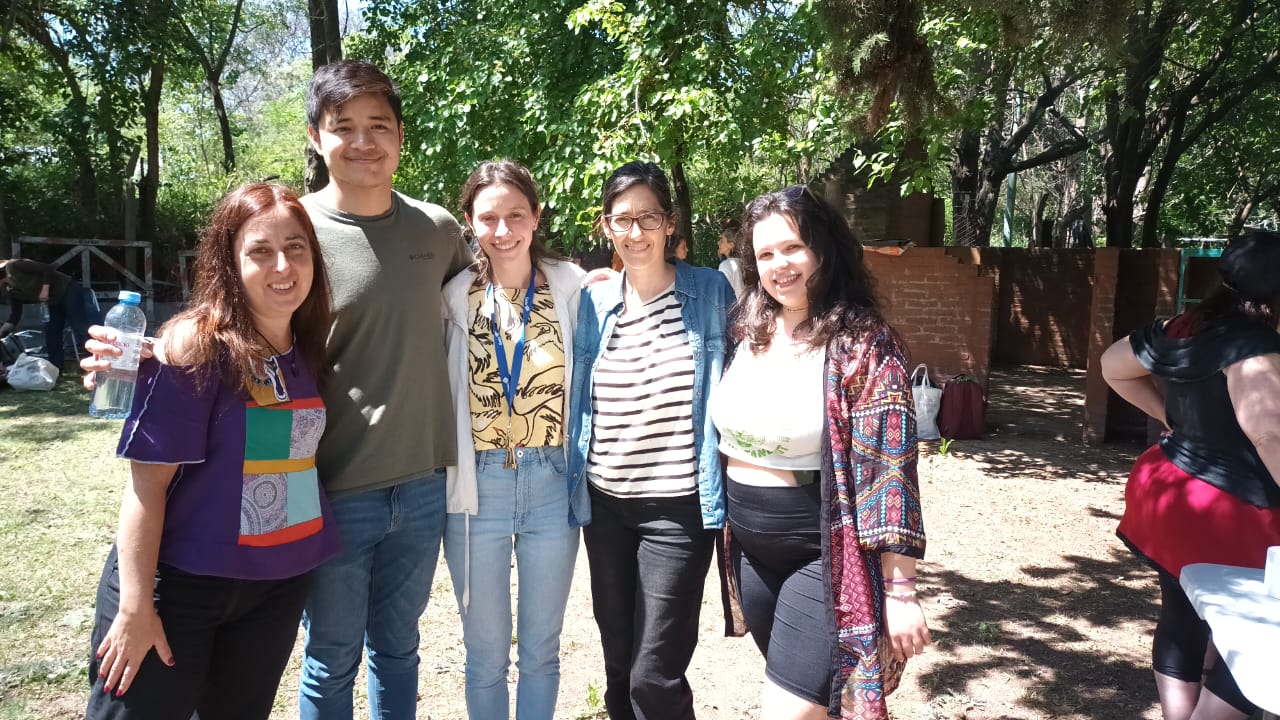
Members:
Natalia Macchiaroli
macchiaroli.natalia@gmail.com
Assistant Investigator CONICET
Lucas Federico Arce
lucasfarce.lfa@gmail.com
PhD fellow ANPCyT
Ines Sananez
ines.sananez@gmail.com
Postdoctoral fellow CONICET
Juan Pablo Arrabal
jparrabal.vet@gmail.com
PhD fellow UNL-INMet
Marina Luz Ingravidi
maru.luz98@hotmail.com
PhD fellow CONICET
Kevin Calupiña
davidcalupina08@gmail.com
Master student, Molecular Biology UBA
Outreach notes
- https://www.conicet.gov.ar/mapa-genetico-de-la-tenia-una-ruta-hacia-la-cura/.
- https://www.agenciacyta.org.ar/2016/06/avance-contra-una-grave-enfermedad-que-transmiten-los-perros/.
- https://www.youtube.com/watch?v=QCCIIjwx_fY
- “https://m24digital.com/cientificos-argentinos-avanzan-en-el-tratamiento-de-la-hidatidosis-una-enfermedad-grave-transmitida-por-perros/.
Outstanding publications
- https://www.ncbi.nlm.nih.gov/pubmed/?term=Kamenetzky+l
Collaborators
NATIONAL
Centro de Investigación en Señales, Sistemas e Inteligencia sinc(i), UNL
>Dr. Diego Milone
>Dra. Georgina Stegmayer
ANLIS-Dr. Carlos G. Malbrán
>Dra. Silvana Carnevale
Instituto de Investigaciones Bioquímicas de La Plata (INIBIOLP), UNLP
>Dra. Gisela Franchini
FVET, UNL
>Dr. Pablo Beldoménico
INBIRS-FMED-UBA
>Dra. Gabriela Turk
>Dr.Daniel Salomón
>Dr. Jorge Geffner
Nanobiotec-FFyB-UBA
> Dr. Alejandro Nusblat
IMPAM-FMED-UBA
>Dra. Marcela Cucher
>Dra. Mara Rosenzvit
>Dra. Maria Luján Cuestas
INTERNATIONAL
Wellcome Sanger Institute, UK
>Dr. Mark Blaxter
ITV, Vale, Brasil
>Dr. Guilherme Oliveira
Tartu University, Estonia
>Dr. Urmas Saarma
Universidad de la República, Uruguay
>Dr. Pablo Smircich
Funding Agencies and Institutions:
UBA, CONICET, ANPCyT, Ministerio de Educación, Perez-Guerrero, Royal Society.